Universe Index
Change one fact and grow it into an explorable alternate-history archive of pages, timelines, and artifacts.
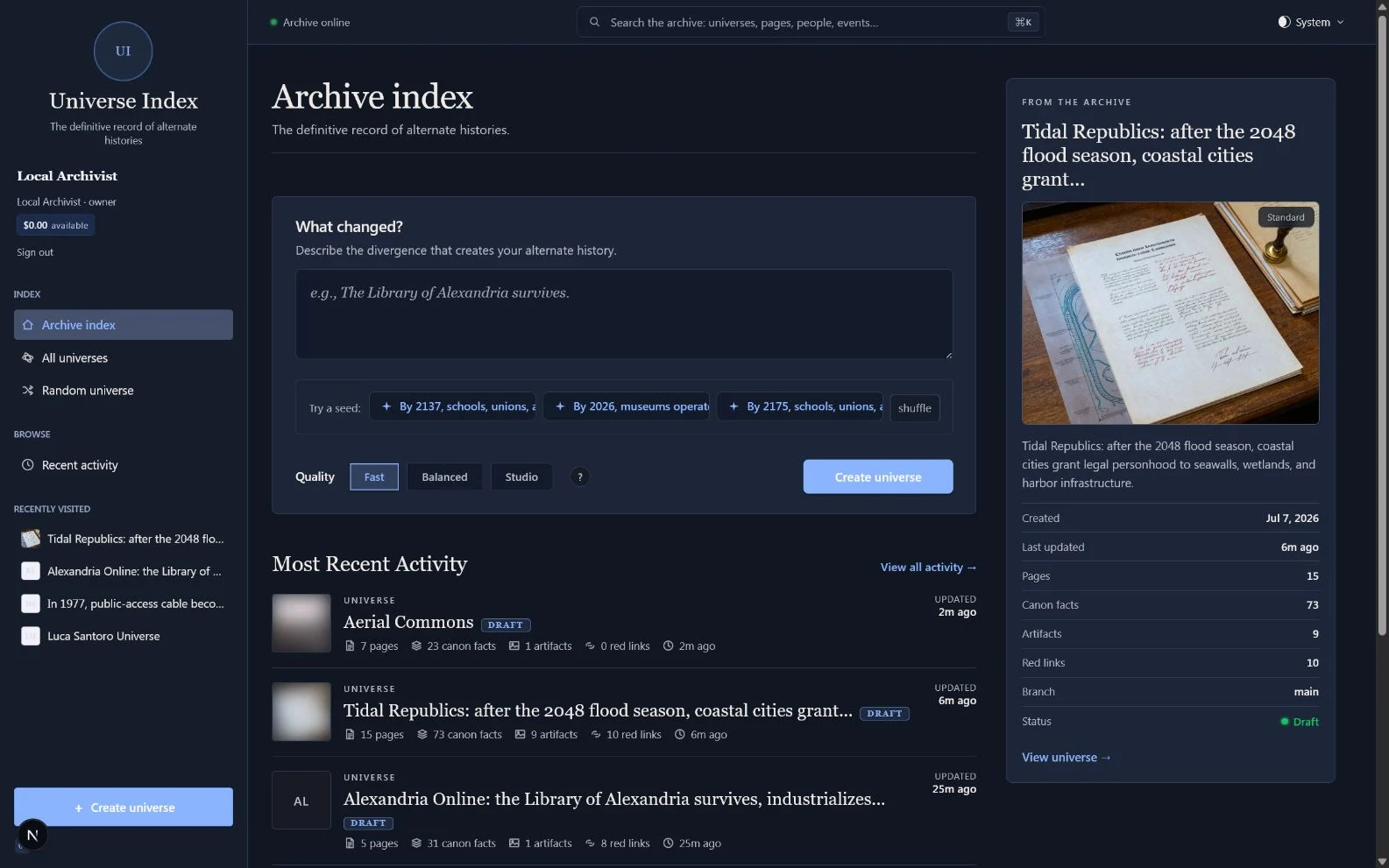
Universe Index starts with one changed fact and grows an alternate-history archive around it. The app turns that premise into canon, timeline events, entities, red links, artifacts, revisions, and article pages that feel discovered rather than written on demand.
I am interested in language models as engines for explorable media, not just text inside a chat box. Here that begins with encyclopedia entries, timelines, and generated images. Eventually a universe might also contain its own music, fake albums, radio stations, documentary clips, maps, posters, and other cultural residue. A different history should produce a different texture.
I steer the premise, simulation rules, and product feel while Codex and Claude handle much of the implementation, debugging, and architecture work. That division lets me keep a large idea moving without giving up the small decisions that make the archive feel coherent.
What It Does
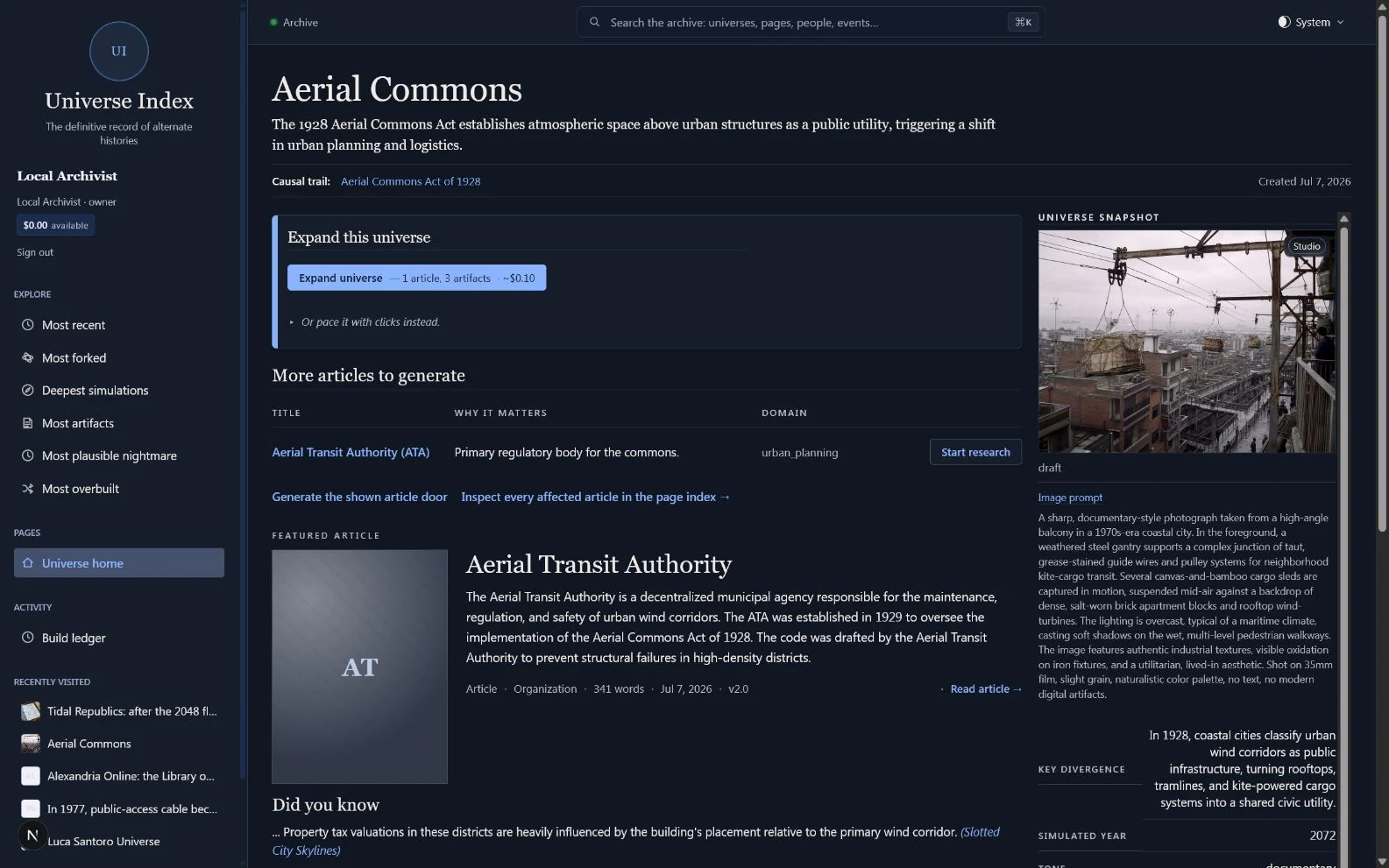
Enter a changed fact and the system builds a living encyclopedia for that timeline. A universe can begin with a handful of pages, then expand through red-link dossiers, affected-page queues, artifact slots, branch forks, proposal review, and simulation jobs.
It is deliberately not a chat app. The archive is the interface: pages, categories, timelines, revision history, canon metadata, red links, and controls for deciding where the simulation should go next. The fun is clicking around a world that feels as if it already exists.
Because the archive is durable, it can hold more than prose. A political movement might accumulate posters and speeches; a city can gain maps and transit diagrams; a fictional music scene can grow artists, album covers, interviews, and eventually its own sound. Each artifact has somewhere to belong instead of vanishing after one generation.
Fresh Generation Run
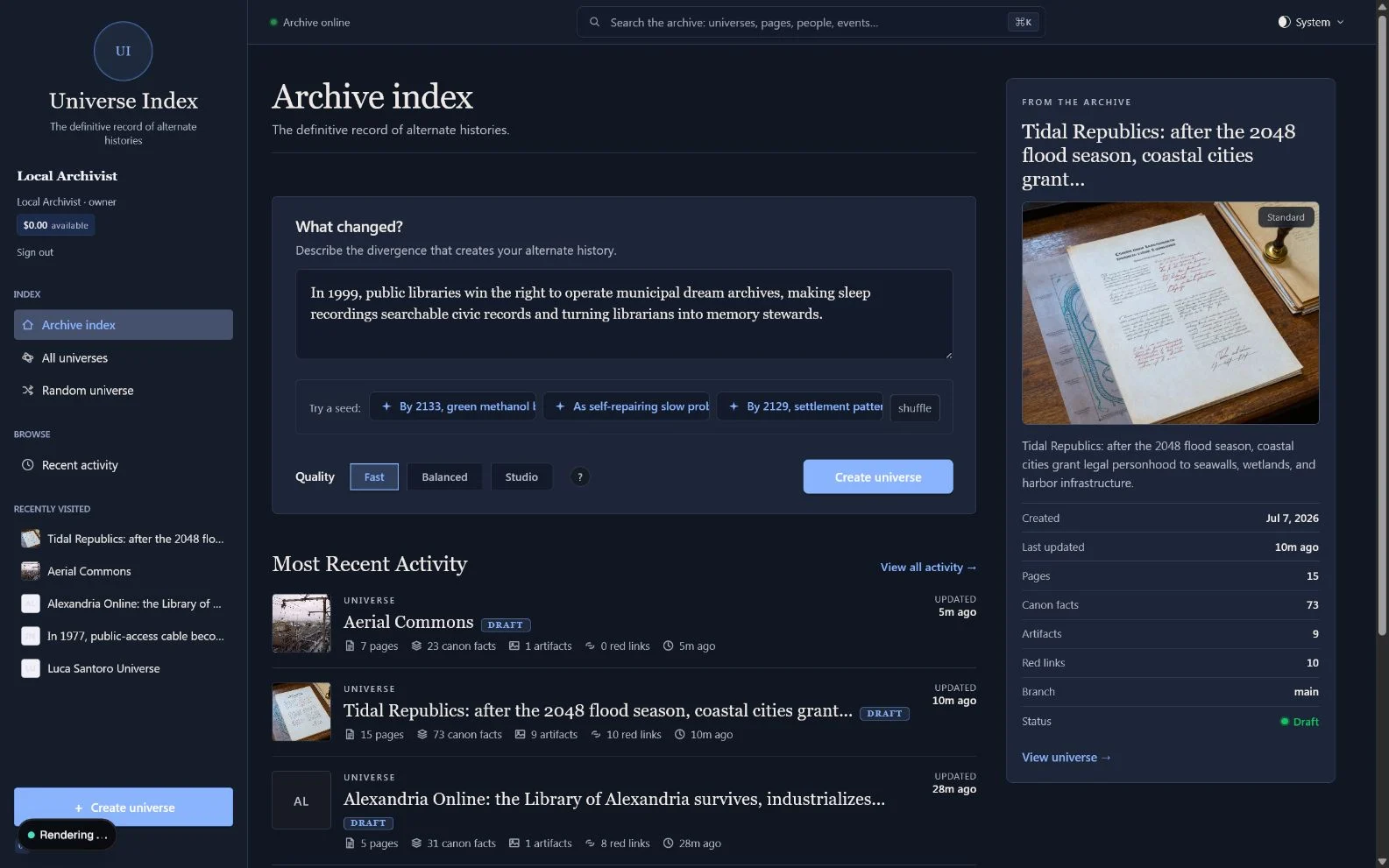
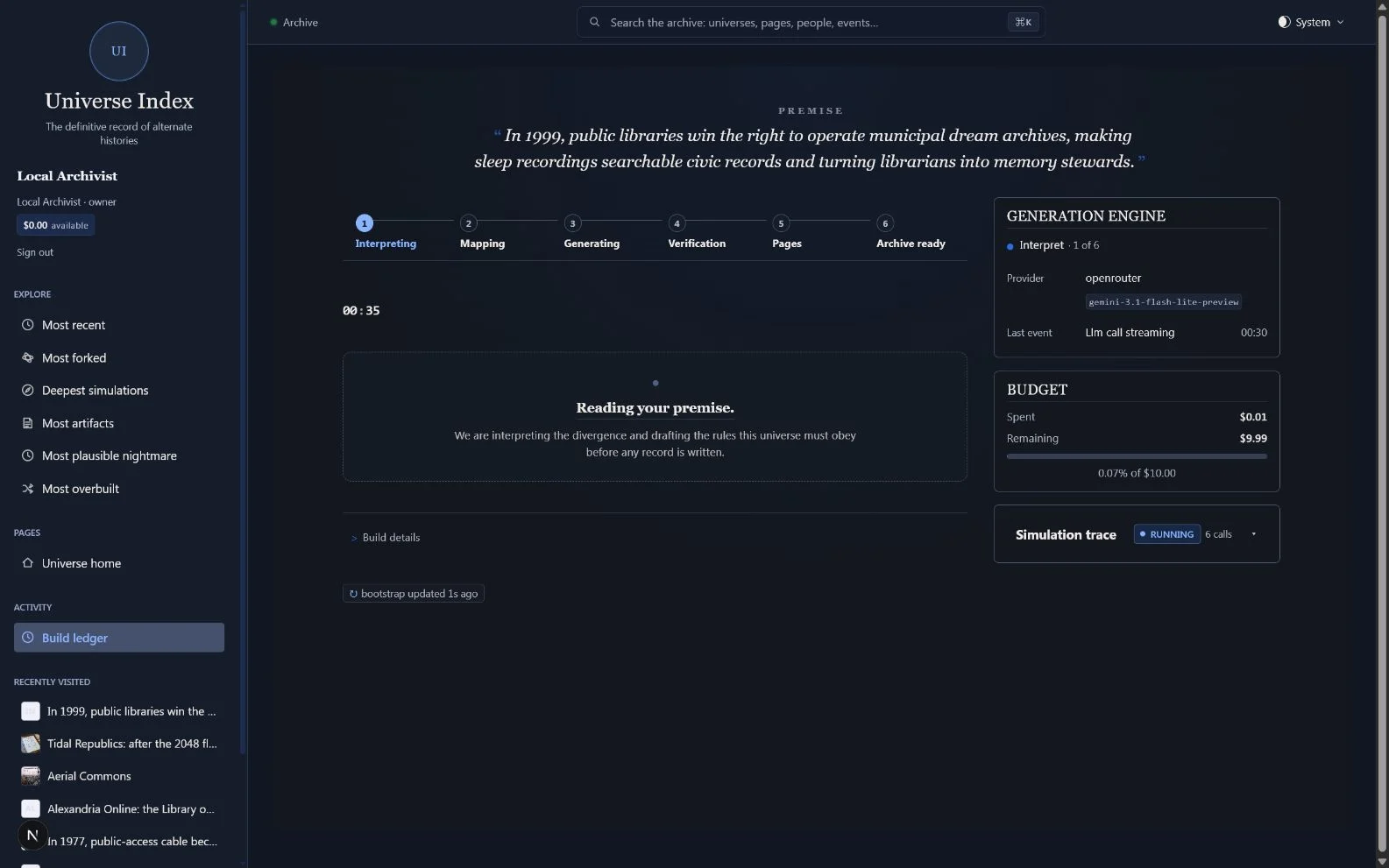
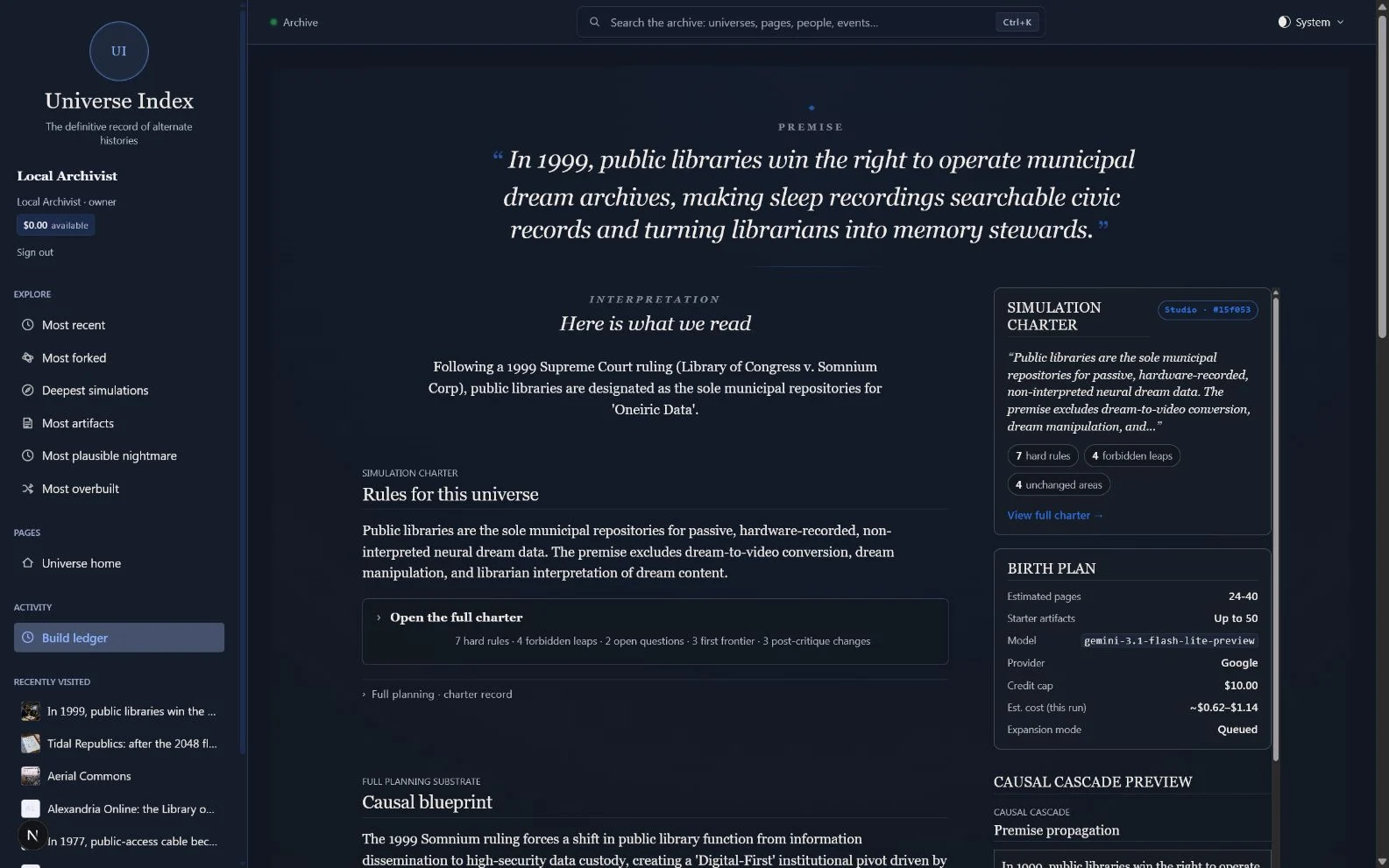
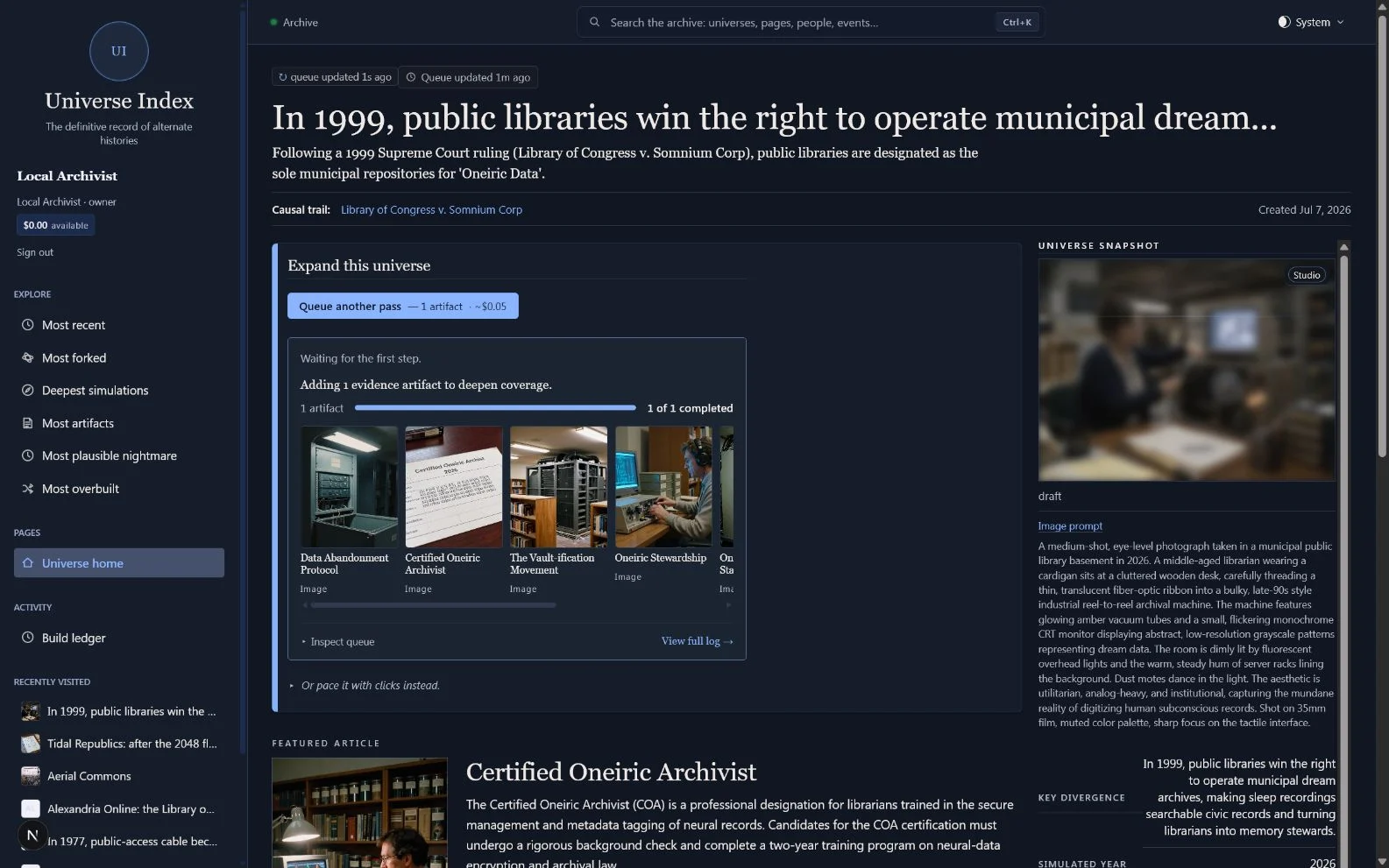
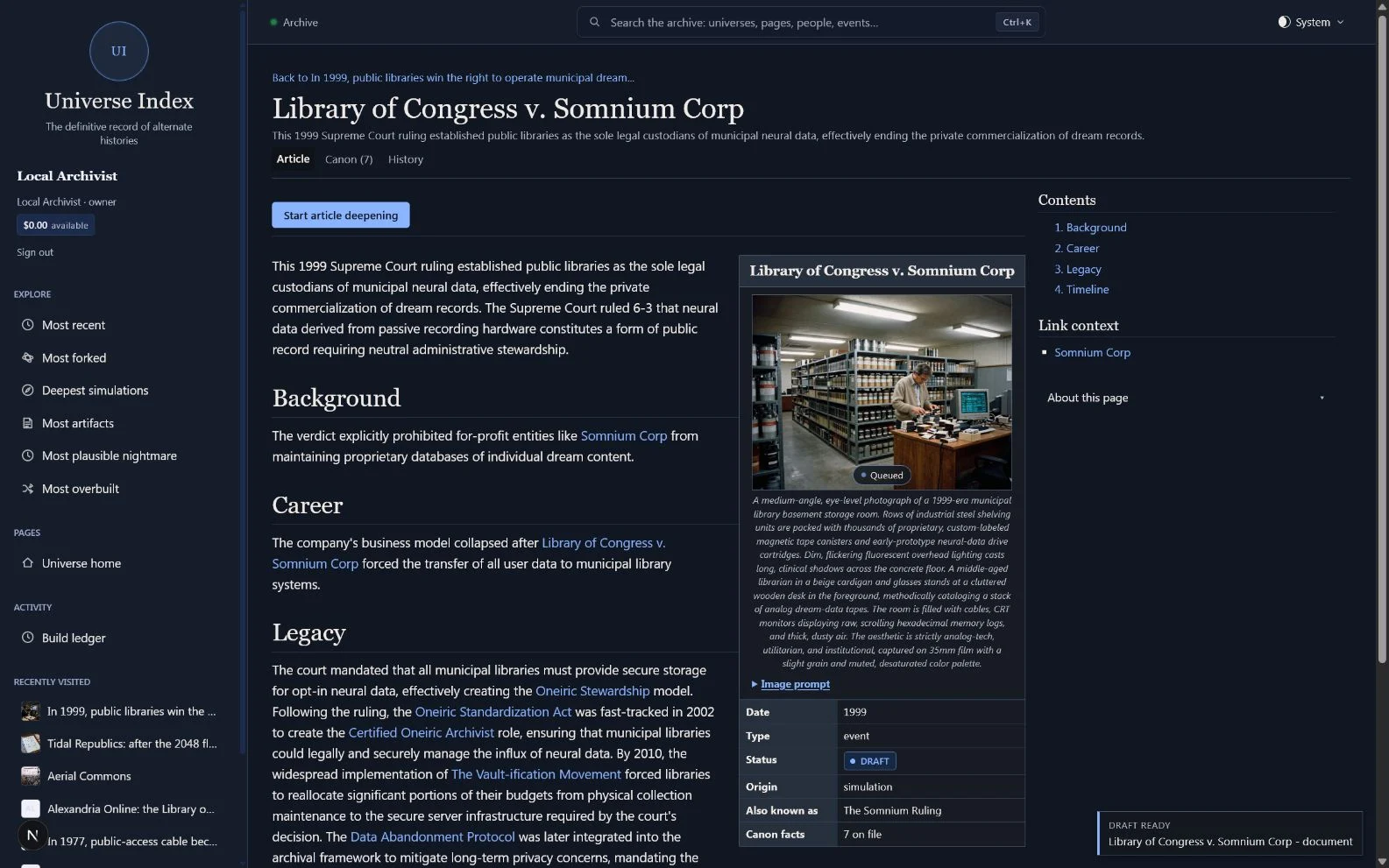
This is a real local run built from a premise about municipal dream archives. The sequence follows the app as it interprets the idea, pauses at the review gate, and turns the accepted charter into pages and generated artifacts.
Why It Is Fun With Agents
Universe Index is well suited to agent-assisted development because one change can touch the interface, database, queues, prompts, simulation rules, image generation, exports, and several small UX decisions at once.
My loop is simple: describe the next behavior, let an agent patch it, run the app, inspect the weirdness, and tighten the direction. Codex handles sustained repo work such as migrations, tests, type errors, queue behavior, and cross-file changes. Claude is useful for product critique, UX simplification, and alternative architecture. Together they feel less like autocomplete and more like a small build team I direct.
That is the vibe-coded part: I am not trying to hand-author every line. I am trying to keep the taste sharp, the premise weird, and the archive alive.
The screenshots are from the live local build, not concept art. They show the loop I care about: premise, interpretation, review, archive birth, generated pages, queue state, and image artifacts living in one product.
Where It Is Going
The north star is an eventually exhaustive encyclopedia simulator—not all of Wikipedia generated at once, but a system where every possible page is addressable and expandable. A small universe might have 25 pages; a deeper run might have hundreds or thousands. Every page becomes durable canon that the user can inspect, revise, fork, dispute, or expand.
I want the same system to support text, images, music, video, and whatever other artifacts make a timeline feel lived in. The agents are not hidden behind a chat box; their work accumulates as a strange, coherent world.
This is also how I like to learn: build the thing, push it until it becomes interesting, and let the next version get stranger and more capable.