Change nothing, fifty times
I asked Codex to edit an image with the instruction "Change nothing." Then I fed the result back in and asked again. Fifty times.

The starting image was a generated studio photograph: a fictional woman, a teal bottle with a printed label, and a white card that said KEEP EVERY DETAIL. I wanted faces, product details, text and a smooth background in the same frame so I could watch what happened to each.
Every edit received only the previous image. No corrections, no returns to the original, no attempts to rescue a bad result. Codex ran the chain, saved every output, and compared each one with both its immediate parent and the original.
The damage started much earlier than the final image suggests. After one or two edits, the skin was already becoming wavy and glossy. By five, the face looked waxier and the bottle's surface had changed. Later, eyelashes clumped together, the cap and carry loop distorted, teal turned to bright cyan, and the grey backdrop developed a purple texture of its own.
The text held on longer. OCR recovered all five target strings through edit 24, well after the image had visibly deteriorated. The first bottle-label miss came at edit 25. By edit 50, none of the five strings matched exactly. Some were still decipherable to me, so an OCR miss isn't the same thing as unreadable text.
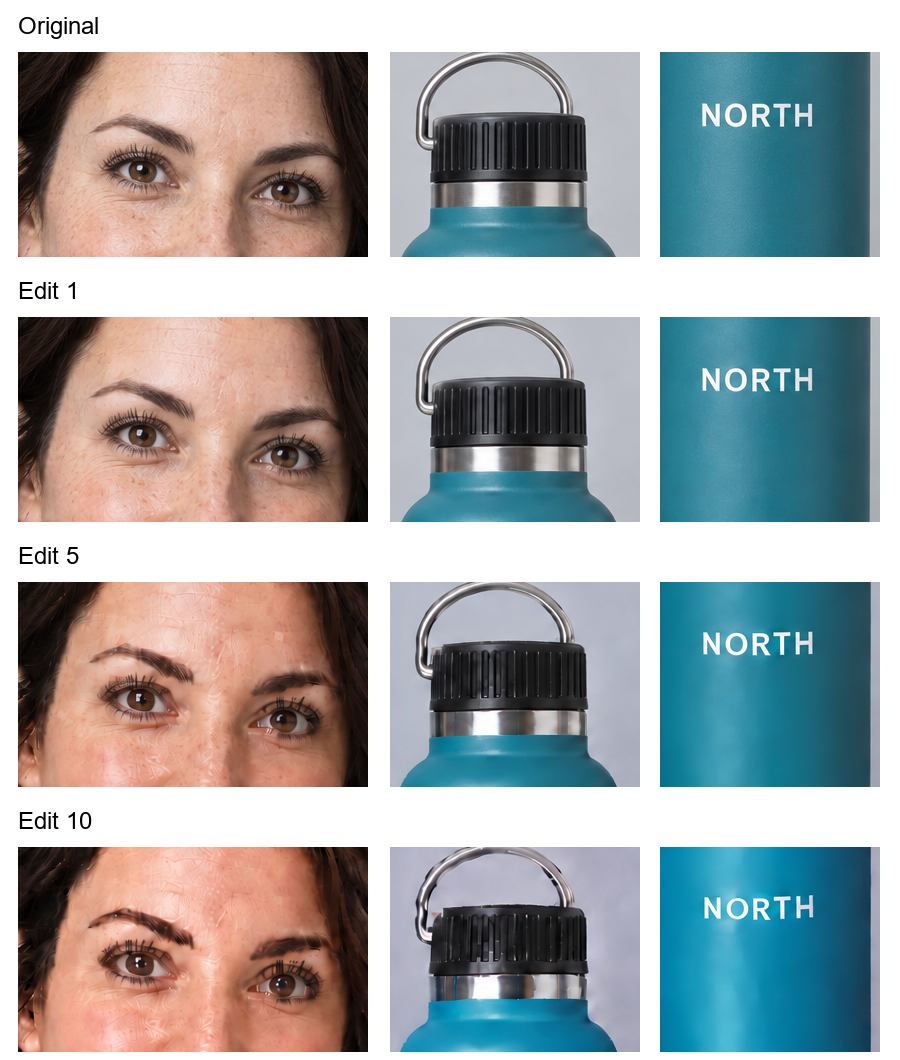
What I found most interesting was how well the scene held together while its surfaces fell apart. The woman was still on the left, the bottle on the right, and the card underneath. A quick check for the right objects and the right words would have missed a lot.
This is why I keep a clean original when revising generated images. Comparing only with the previous edit makes a long slide look like a series of small changes. I want to compare with the image I actually liked, especially around faces, lettering and product details.
This was one image and one chain through Codex's built-in image generation tool. It doesn't establish a safe number of edits, and the tool didn't expose a backend model identifier. It does make the cumulative damage unusually easy to see.
Download the measurements (CSV). My earlier recursive-grain test looked at the same problem over a shorter chain.