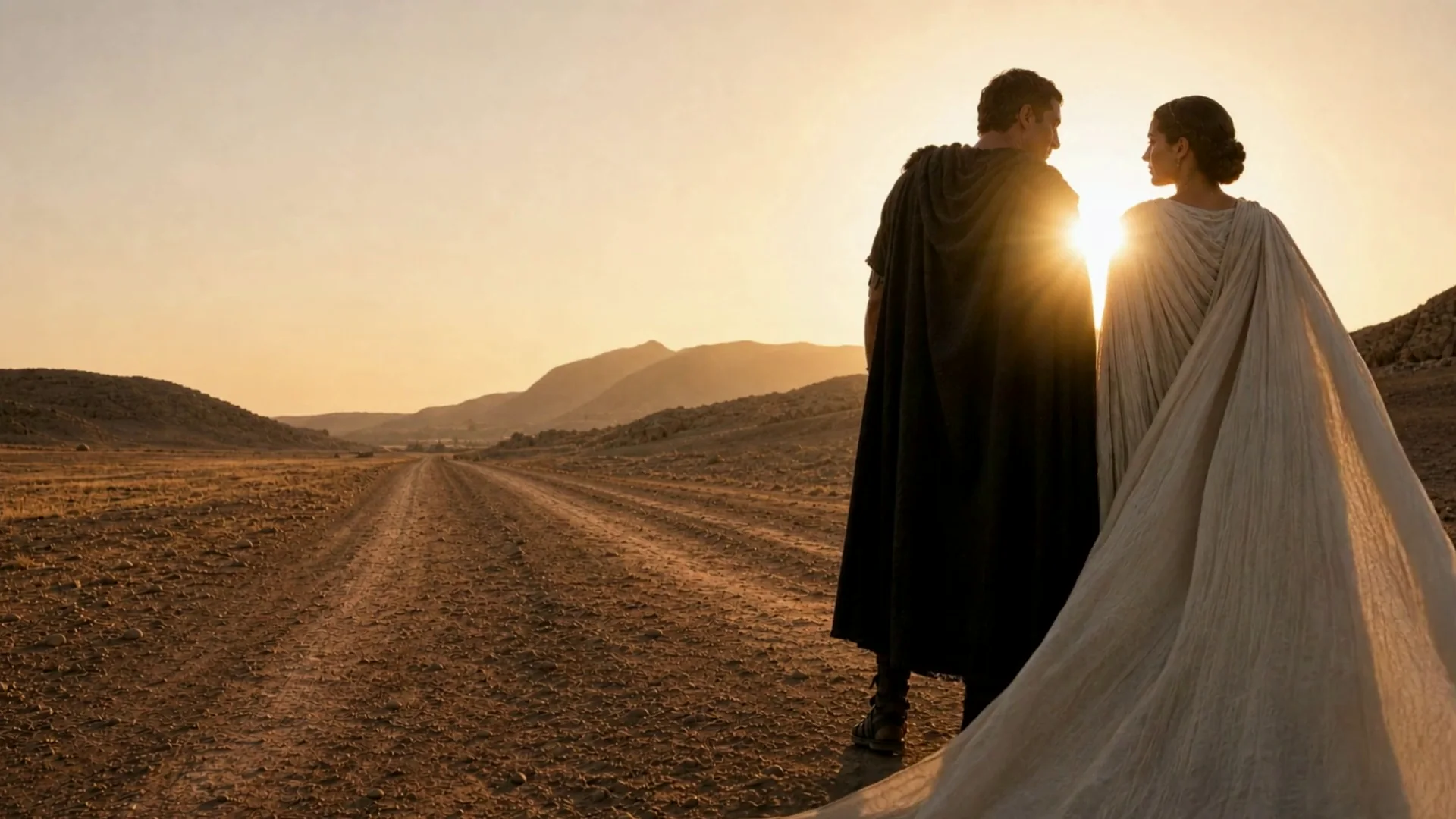
Cleopatra and Mark Antony recast in a backlit contemporary desert fashion film frame.

project / code

Visual Cover Production Engine

DateAugust 2026
CategoryAI Film, Codex, Generative Video
StackCodex, Kling 3.0, FFmpeg

Record

  • 30-shot first cover completed
  • 1,070-frame exact conform
  • 37-segment second pilot in production

I wanted to see whether Codex could run an AI film production without forgetting what had already been approved.

The result is a workflow for making visual cover versions of existing films. A strong human-directed source supplies the composition, blocking, wardrobe logic, lighting, pacing, and performance shape. Historical figures become the new cast. Codex manages the production state around them: source analysis, shot manifests, identity continuity, generation, editorial conform, cost boundaries, and quality control.

This is not a prompt that produces a finished movie. It is a system for carrying decisions across dozens of shots.

A silent portfolio reel from the completed Dalí and Picasso pilot. It contains generated footage only, with the source soundtrack, publisher branding, and end card removed.

From One Experiment to a Production System

In 2024 I made GQ Einstein + Lincoln, replacing the people in a fashion film with historical figures and animating selected frames. It worked as a one-off piece, but every good result was still fragile. There was no durable record of which face, frame, timing decision, or motion attempt should survive into the next version.

The Visual Cover Production Engine turns that experiment into a recoverable production process. Every project has a source contract, a shot manifest, an identity bible, approved frames, motion candidates, exact edit timing, provider receipts, and a final QC record. A failed shot can be replaced without reopening the entire film.

The Source Film Is the Score

Generative video is good at producing a striking moment. It is much less reliable at inventing and sustaining a complete visual language across a sequence.

The source film solves a different problem. It already contains decisions about where the camera sits, how two people share a frame, when a cut happens, how clothing moves, and how the energy changes from one shot to the next. The engine treats those decisions as a production score rather than asking the model to rediscover them.

The creative unit is not just a historical pair or a visual reference. It is the relationship between them. A source built around rivalry, intimacy, status, friendship, or performance only works when that behavior reveals something useful about the new cast.

Pilot 00: Dalí and Picasso

The first completed cover replaces the two subjects in a 44-second fashion film with Salvador Dalí and Pablo Picasso. The final cut contains 30 shots, preserves the original 1,070-frame picture duration, and keeps every earlier version available for comparison.

A labeled contact sheet of 29 generated Dalí and Picasso shots spanning pools, roads, gardens, portraits, and motorcycle sequences.
Twenty-nine generated shot midpoints from the final conform. The publisher end card is deliberately excluded from this public sheet.

The final repair did not regenerate the whole movie. Codex isolated three remaining problems, preserved every accepted segment, and rebuilt only the affected material. One clean provider download replaced a watermarked shot without new credit spend. A fixed watermark was removed with a tightly bounded mask. One inherited transition frame was replaced while keeping the original four-frame transition duration.

A wide first-and-last-frame contact sheet used to inspect motion continuity across selected Dalí and Picasso shots.
First and last frames from the motion package. These sheets make identity drift, frozen movement, and broken endpoints visible before the edit is promoted.

What Codex Runs

  1. Source audition. Inspect candidate films and record shot count, locations, subjects, wardrobe changes, choreography, continuity burden, and transformation potential.
  2. Exact decomposition. Convert the selected edit into a manifest with timecodes, duration, composition, camera, light, wardrobe, action, transition, and continuity dependencies.
  3. Identity lock. Establish one approved visual authority for each recurring character before generating dependent shots.
  4. Start-frame production. Match the source composition and approve identity before spending on motion.
  5. Motion generation. Preserve the provider, model, prompt, settings, references, job receipt, cost, failures, and selected candidate for every shot.
  6. Original-timing conform. Rebuild the edit at its exact shot durations instead of hiding timing problems with arbitrary speed changes.
  7. Timeline QC. Decode the result into contact sheets and inspect identity, faces, hands, clothing, environments, physics, transitions, timing, and visual repairs.

The models are replaceable. The accepted artifacts, state transitions, and production lineage are the durable part.

Pilot 01: Cleopatra and Mark Antony

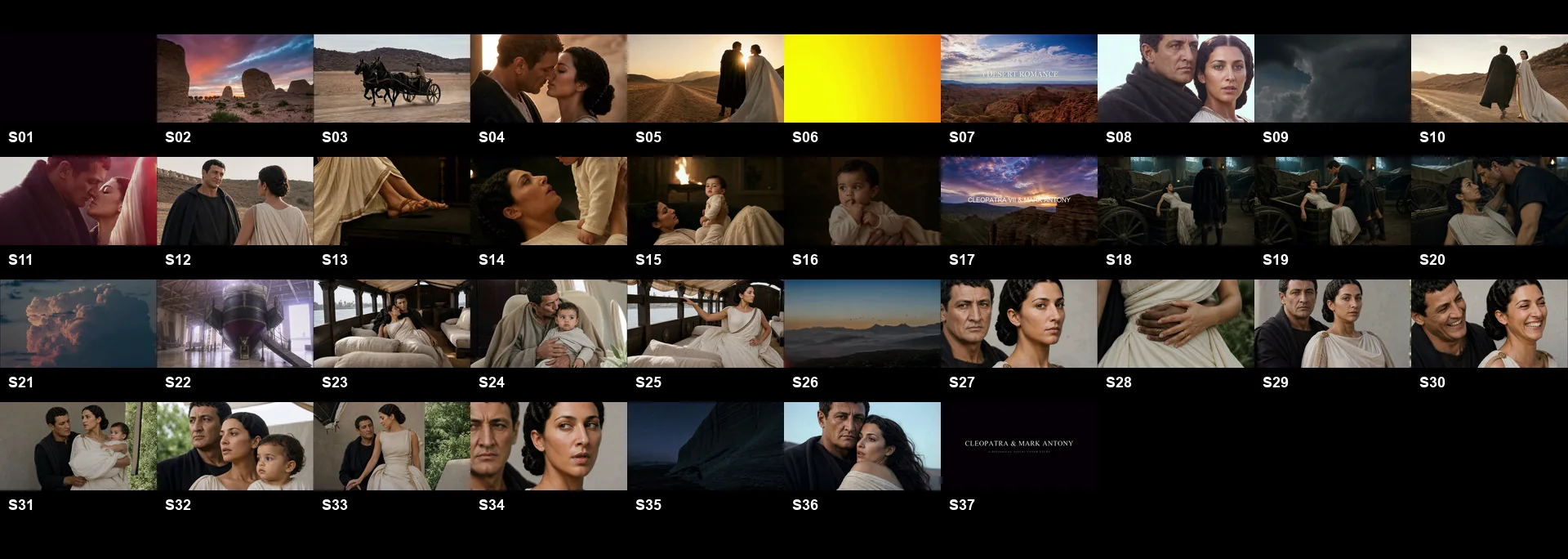
The active pilot recasts Cleopatra VII and Mark Antony into a 37-segment desert fashion film. The first step was not generating all 37 shots. It was establishing two faces that could survive profile intimacy, extreme backlight, a tight paired portrait, and a rear full-body walk.

Generated canonical identity portraits for Cleopatra VII and Mark Antony.
The approved identity anchors. Later scene outputs can inherit these faces, but they cannot silently replace them.
Four generated Cleopatra and Mark Antony start-frame candidates showing a pre-contact close-up, strong backlight, a tight paired portrait, and a rear road walk.
The first continuity stress test. S05, S08, and S10 are strong candidates. S04 is deliberately staged just before contact so motion can create the brief greeting without fusing either face.

The batch holds together as one cast, but the differences are recorded instead of hidden. S04 still needs a tighter crop and a small hand-position correction during motion and conform. S08 needs its gaze directed farther off camera. Those notes become production instructions for the next stage rather than reasons to restart the identities.

The source has been mapped into 37 deterministic segments. Both identities are approved. The first image gate is complete. No paid video jobs have been submitted for this pilot.

What Comes Next

The next test is motion. The cast has to remain recognizable while heads turn, bodies cross the frame, fabric moves, scale changes, and independently generated clips return to the original edit timing.

If that works, the engine moves from a strong image workflow to a real production system: one that can resume, repair a named failure, change providers, and improve a film without losing everything it already solved.

This public case study uses generated-only media derivatives. Source-film frames, original soundtracks, publisher marks, private research material, and unresolved release assets remain outside the page.